
How Machine Learning Algorithms Really Work

A Deep Dive into the Brains Behind Modern AI
Machine Learning (ML) has become one of the most influential technologies of our time. From Netflix recommendations and Google search rankings to fraud detection, autonomous vehicles, and medical diagnostics, ML algorithms quietly shape the digital world around us.
But despite its widespread use, machine learning is often misunderstood. It’s frequently described as “magic,” “black boxes,” or systems that somehow learn like humans. In reality, ML is grounded in mathematics, statistics, optimization, and logic — powerful, but far from mystical.
In this article, we’ll explore:
What machine learning actually is
How ML algorithms work at a fundamental level
The major types of machine learning
Popular algorithms within each category
How models are trained, evaluated, and improved
Where ML struggles and why that matters
This guide is intentionally detailed, designed for readers who want a solid mental model of ML — not just surface-level definitions.
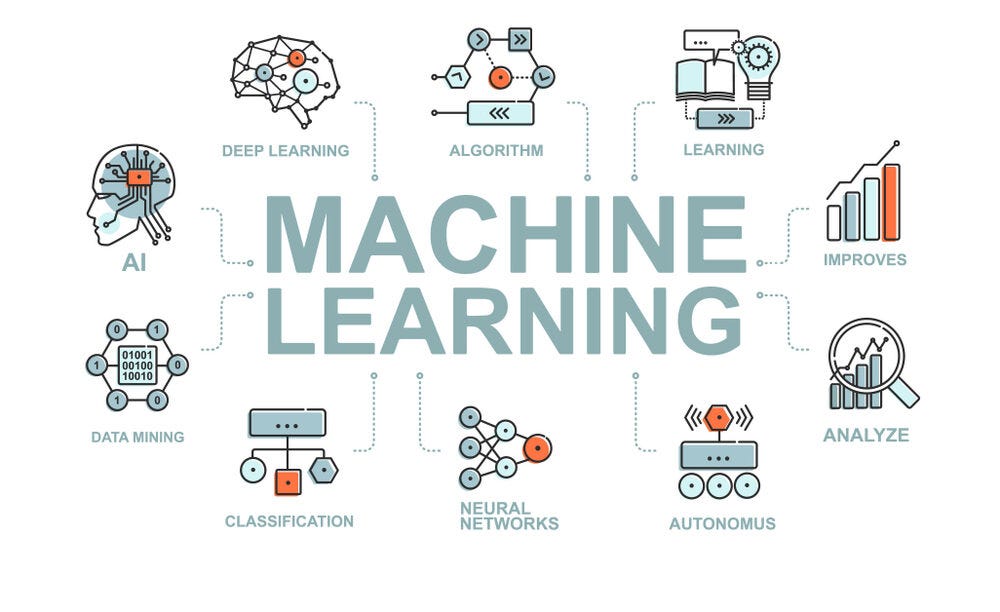
1. What Is Machine Learning, Really?
At its core, machine learning is about finding patterns in data.
More formally:
Machine learning is a field of computer science that enables systems to learn patterns from data and make predictions or decisions without being explicitly programmed for every scenario.
Traditional software works like this:
Input → Rules → Output
Machine learning flips that around:
Input + Output → Rules (Model)
Instead of writing rules manually, we provide:
Data (examples)
Desired outcomes (labels, rewards, or objectives)
The algorithm then infers the rules on its own.
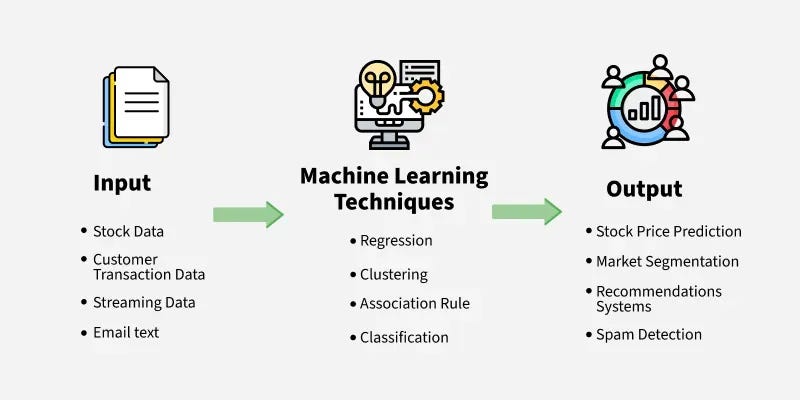
2. The Building Blocks of Any ML Algorithm
Regardless of complexity, almost all ML algorithms share the same fundamental components:
2.1 Data
Data is the fuel. It can be:
Numbers (prices, temperatures)
Text (emails, articles)
Images (photos, scans)
Audio (speech, music)
Time-series (stocks, sensor readings)
Bad data → bad models. No algorithm can overcome poor or biased data.

2.2 Features
Features are the measurable properties of the data.
Examples:
For a house price model: size, location, bedrooms
For email spam detection: word frequency, sender reputation
For images: pixel values, edges, shapes
Feature engineering — choosing what the model sees — is often more important than the algorithm itself.
2.3 Model
A model is a mathematical function that maps inputs to outputs.
Examples:
A line (linear regression)
A decision tree
A neural network with millions of parameters
The model contains parameters (weights, coefficients) that get adjusted during training.
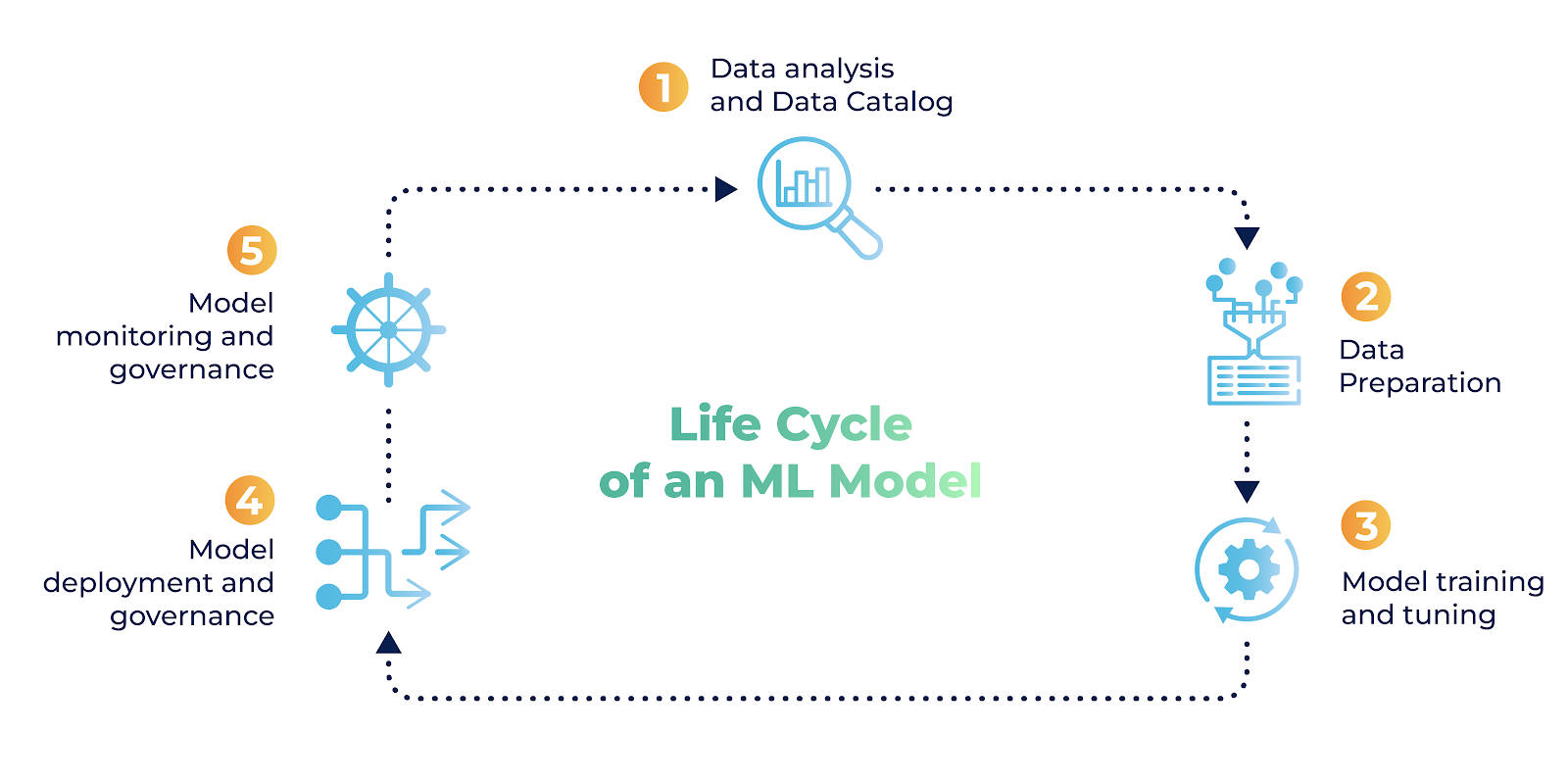
2.4 Loss Function
The loss function answers one question:
How wrong is the model?
Examples:
Mean Squared Error (regression)
Cross-Entropy Loss (classification)
Custom reward functions (reinforcement learning)
The model’s goal is to minimize loss.
2.5 Optimization Algorithm
Optimization is how the model improves.
Most ML models use variants of:
Gradient Descent
Stochastic Gradient Descent (SGD)
Adam, RMSProp, etc.
These methods adjust parameters step by step to reduce error.
3. How Machine Learning Models Learn (Step-by-Step)
Let’s simplify the learning process:
Initialize model parameters randomly
Make predictions on training data
Calculate error using the loss function
Adjust parameters to reduce error
Repeat thousands or millions of times
This process is called training.
Eventually, the model converges to a state where it performs well — not just on known data, but on unseen data.
4. The Main Types of Machine Learning
Machine learning is typically divided into four major categories:
Supervised Learning
Unsupervised Learning
Semi-Supervised Learning
Reinforcement Learning
Let’s explore each in depth.
5. Supervised Learning
5.1 What It Is
Supervised learning uses labeled data — each example comes with a correct answer.
Example:
Input: Email text Label: Spam / Not Spam
The model learns to map inputs to outputs.
5.2 Common Use Cases
Price prediction
Medical diagnosis
Credit scoring
Image classification
Speech recognition
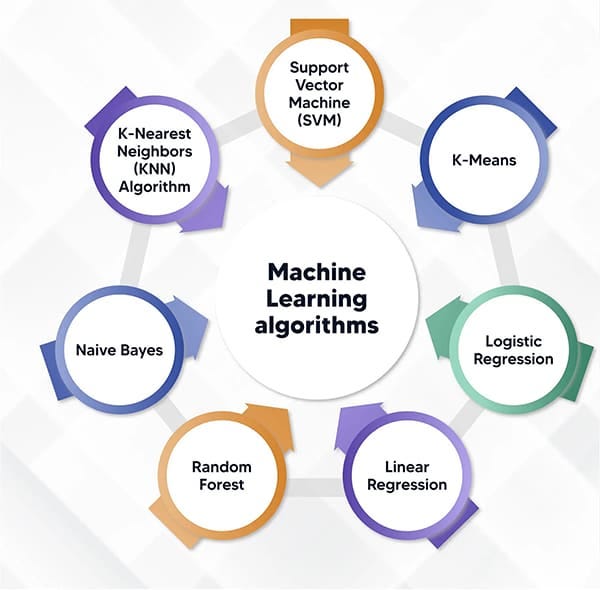
5.3 Major Supervised Learning Algorithms
Linear Regression
Predicts continuous values
Fits a straight line (or plane)
Simple, interpretable, fast
Used when relationships are roughly linear.
Logistic Regression
Used for classification
Outputs probabilities
Despite the name, it’s a classification algorithm
Decision Trees
Splits data using “if-then” rules
Easy to visualize
Prone to overfitting
Random Forests
Collection of decision trees
Reduces overfitting
Strong performance with minimal tuning
Support Vector Machines (SVM)
Finds optimal boundaries between classes
Powerful for high-dimensional data
Computationally expensive at scale
k-Nearest Neighbors (k-NN)
Makes predictions based on nearest data points
No training phase
Slow for large datasets
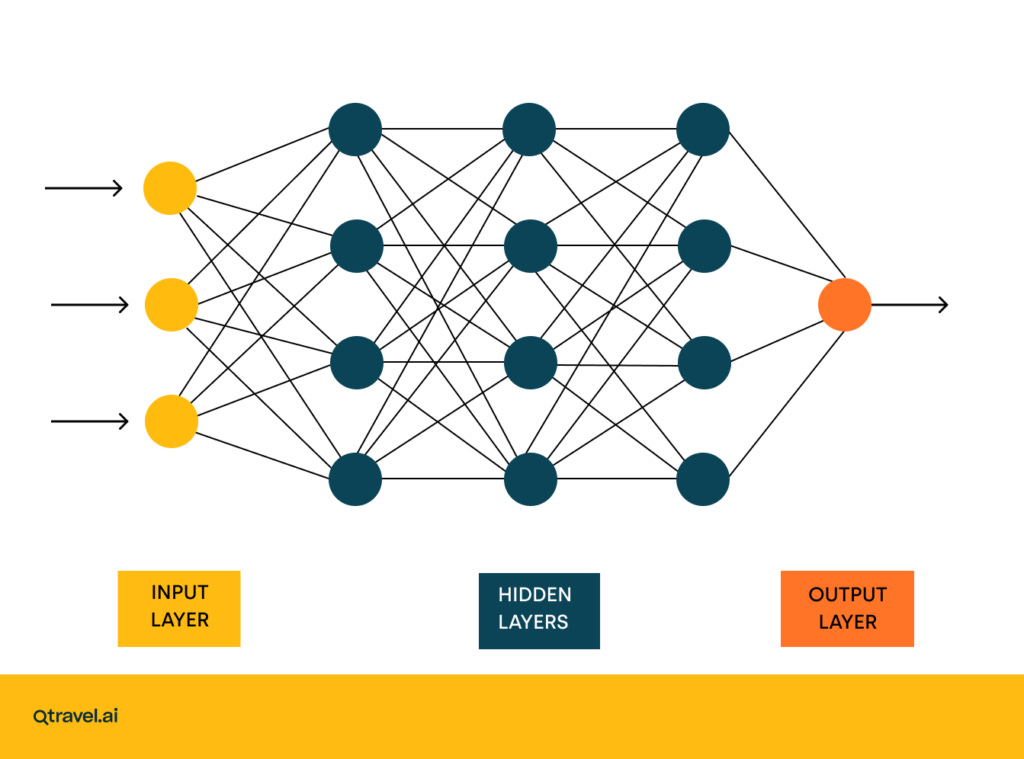
Neural Networks
Inspired by biological neurons
Can model highly complex relationships
Backbone of deep learning
6. Unsupervised Learning
6.1 What It Is
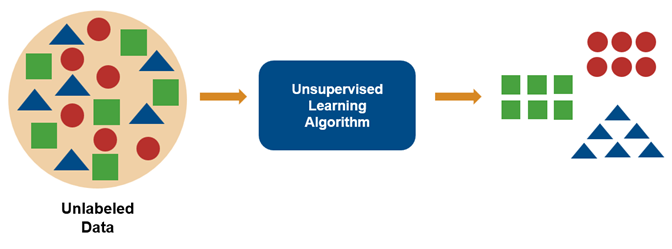
Unsupervised learning uses unlabeled data.
The goal is to discover hidden structure.
6.2 Common Use Cases
Customer segmentation
Anomaly detection
Topic modeling
Dimensionality reduction
6.3 Major Unsupervised Learning Algorithms
k-Means Clustering
Groups data into k clusters
Simple and fast
Requires choosing k in advance
Hierarchical Clustering
Creates tree-like cluster structures
No need to predefine cluster count
Computationally expensive
DBSCAN
Density-based clustering
Finds arbitrary-shaped clusters
Handles noise well
Principal Component Analysis (PCA)
Reduces dimensionality
Preserves variance
Used for visualization and compression
Autoencoders
Neural networks that compress and reconstruct data
Used for anomaly detection and representation learning
7. Semi-Supervised Learning
7.1 Why It Exists
Labeling data is expensive and slow.
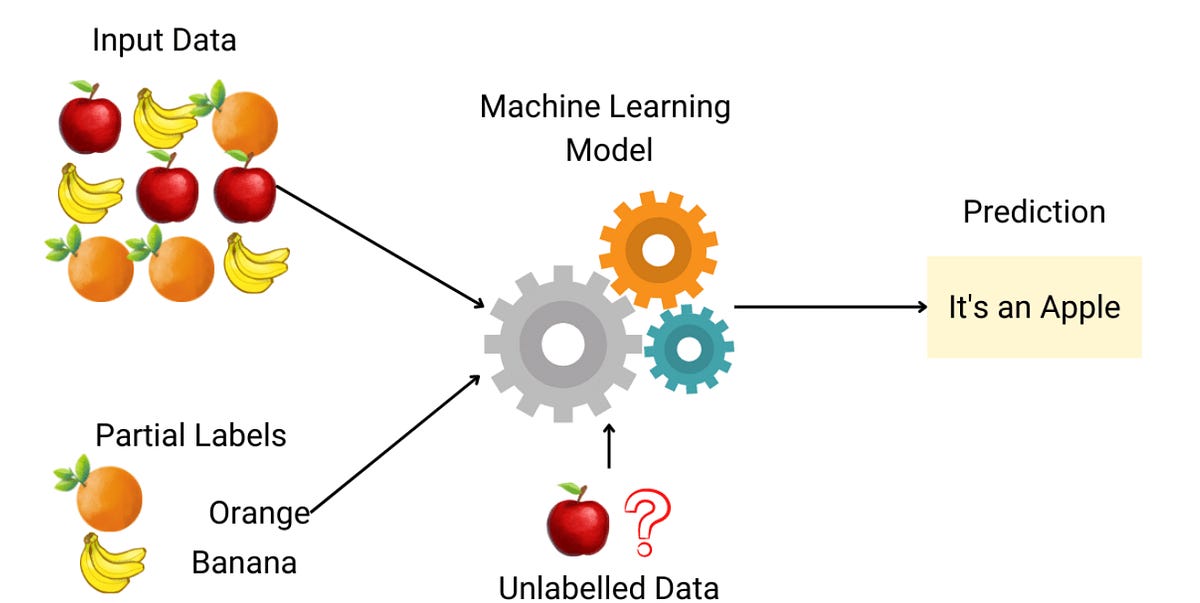
Semi-supervised learning combines:
Small labeled datasets
Large unlabeled datasets
7.2 How It Works
The model:
Learns from labeled data
Makes confident predictions on unlabeled data
Uses those predictions as pseudo-labels
Retrains itself
7.3 Use Cases
Medical imaging
Speech recognition
Web-scale classification tasks
8. Reinforcement Learning (RL)
8.1 What It Is
Reinforcement learning is about decision-making over time.
An agent interacts with an environment:
Takes actions
Receives rewards or penalties
Learns a strategy (policy)
8.2 Core Concepts
Agent
Environment
State
Action
Reward
Policy
8.3 How Learning Happens
The agent tries actions → observes outcomes → updates behavior to maximize long-term reward.
8.4 Popular RL Algorithms
Q-Learning
Deep Q Networks (DQN)
Policy Gradient Methods
Proximal Policy Optimization (PPO)
8.5 Real-World Applications
Game AI (Chess, Go)
Robotics
Trading systems
Autonomous vehicles

9. Deep Learning: ML at Scale
Deep learning is a subset of ML using large neural networks.
Key ideas:
Multiple layers (deep architectures)
Automatic feature extraction
Massive datasets and compute
9.1 Types of Neural Networks
Feedforward Neural Networks
Basic prediction models.
Convolutional Neural Networks (CNNs)
Designed for images
Detect edges → shapes → objects
Recurrent Neural Networks (RNNs)
Handle sequential data
Used for text and time-series
Transformers
Power modern language models
Use attention mechanisms
Scale extremely well

10. Training, Validation, and Testing
A proper ML pipeline splits data into:
Training set – learns patterns
Validation set – tunes hyperparameters
Test set – final evaluation
This prevents overfitting — when a model memorizes instead of generalizing.
11. Common Challenges in Machine Learning
11.1 Overfitting
Model performs well on training data but fails in the real world.
11.2 Bias and Fairness
Models learn biases present in data.
11.3 Interpretability
Complex models are hard to explain.
11.4 Data Drift
Real-world data changes over time, degrading performance.
12. Final Thoughts: ML Is Powerful — But Not Magic
Machine learning is not intelligence in the human sense. It does not “understand” or “reason” — it optimizes mathematical objectives based on data.
Yet, when applied carefully, ML becomes an incredibly powerful tool:
It scales human decision-making
It reveals patterns invisible to us
It automates complexity
Understanding how ML algorithms work demystifies AI — and empowers you to build, evaluate, and use these systems responsibly.